
Catalogue · Berliet
Berliet: the Marius Berliet cars sold by the Auto Garage Términus in Barcelona (1904)
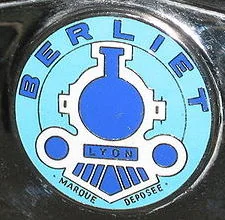
The Berliets of the Auto Garage Términus (1904)
In Los Deportes, 8 May 1904: "The two 24 H.P. Berliet cars we saw at the Garage Términus of Messrs Balet and brother are currently out on a trip to test their splendid hill-climbing qualities on the slopes of El Bruc. […] then to continue on the road to Puigcerdà."
Los Deportes, 15 May 1904: "We are told that in a few days several Berliet cars will arrive in this city, one of 40 H.P., another of 12 and another of 24, which may be admired at the Autogaraje Términus of Messrs Balet Brothers, at number 290, Calle de Valencia."
More details in the history of the Auto Garage Términus.
Who founded Berliet? Marius Berliet and Automobiles M. Berliet (Lyon, 1895–1901)
A major French motor company named after its founder, Marius Berliet, who built his first rudimentary vehicle in 1895–1896. Having won the trust of a few supporters who asked him for more examples, he was able to commission Audibert & Lavirotte to build a car of his own design, which he had at first assembled in a small workshop. The liquidation of Audibert & Lavirotte allowed him in 1901 to buy its premises, increase production and set up Automobiles M. Berliet, in which the Berliet family long remained the main shareholder.
The first Berliet model (1895) was a vehicle with some remarkably original features and one of the few that did not rely on proven De Dion or Aster units. The whole engine-gearbox-transmission assembly, mounted at the rear on a subframe hinged to the main frame, could be removed without separating its components, as in much more modern vehicles. For 2 years Berliets were fitted with a water-cooled two-cylinder monobloc engine and a 4-speed gearbox. Among the unusual features for the period was pre-heating of the mixture, achieved by placing the carburettor next to the exhaust pipe. By 1901, after building some 70 examples of the earlier models, Berliet introduced a 4-cylinder car with secondary chain drive: the 22 HP type.
The early years of the century saw Berliet grow considerably, reaching its peak in 1906–1907, at the height of the European motor-car boom.
Berliet was at the forefront with a range of 5 basic models in various versions, obtained by cleverly combining just 3 cylinder bore sizes and 2 stroke lengths. The conventional 40 hp model came in 4- and 6-cylinder versions, while the large 6-cylinder, 60 hp model could be fitted with a compressed-air device powerful enough to serve not only for starting but also to assist the engine under heavy load. In fact, the most successful and widespread Berliet was the mid-sized 22 HP type, produced with chain or shaft drive and with 4 different chassis lengths to suit the various body styles. The engine had a displacement of 3,768 cc (100 x 120 mm) and an effective output of around 35 hp. These were also the years of sporting success: in 1906 Bablot took second place in the Tourist Trophy, arousing great interest in Britain. Also in 1906, a representative of the American Locomotive Corporation came to France to buy a licence. The choice fell on the Berliet 40 HP, and the rights were granted for a "legal" reproduction in the United States under the Alco brand. The deal was highly profitable for Berliet, which used the proceeds to build new works at Monplaisir, near Lyon, to replace the Audibert & Lavirotte premises, which had become too small.
While Alco won some sporting glory in 1910 by taking the Vanderbilt Cup, Berliet's own racing efforts with its 60 HP (8.6-litre) and 80 HP (11-litre) models were less fortunate compared with the great European makes.
From the start of the First World War, Berliet suffered from a certain conservatism: the 14 HP model (80 x 120 mm), with 4 cylinders in two blocks, was built for almost 10 years without major changes.
During the war, military orders led to an extraordinary expansion of the works: output reached 40 lorries and 4,000 artillery shells a day. A new plant had to be built on a 400-hectare site at Vénissieux, also on the outskirts of Lyon. In 1917–1918, in addition to its own production, Berliet built more than 1,000 tanks under Renault licence.
Nevertheless, the firm went on building compact, well-designed cars, presenting two new basic models with 4-cylinder monobloc engines between 1919 and 1921: first the 15 HP (80 x 130 mm), followed in 1921 by the more effective 16 HP, whose displacement was increased from 2,614 to 3,308 cc through a considerable increase in cylinder bore (90 x 130 mm). Both side-valve engines had a detachable cylinder head.
Shortly afterwards came 3 similar models with 4-cylinder overhead-valve engines, on which front brakes became standard. These were the 10/20 HP (1,159 cc, 62 x 96 mm), the 15/50 HP (2,500 cc, 78 x 130 mm) and the 23/70 HP (3,964 cc, 95 x 140 mm). Meanwhile the lorries had progressed from the chain-driven C.B.A. type, which distinguished itself during the war, to the heavy three-axle Sahara-Niger (named after a 10,000 km crossing of Africa fully laden). The engine was a 6-cylinder petrol unit: Berliet built diesel engines under Aero licence from 1930, and in 1935 adopted the Ricardo patents.
After a short-lived 6-cylinder overhead-valve car of about 2.5 litres (which took part in the 1923 Le Mans race), there followed a period of rethinking in which all Berliets adopted side-valve engines. From this period came the 6-cylinder 14/40 HP of 1,812 cc (62 x 100 mm), for which a 3-speed gearbox was deemed sufficient; the car was produced from 1927 to 1931.
Car production began to decline in the mid-1930s, despite the launch of the 944 type (1933) in several versions, with a 1.6- or 2-litre engine and side or overhead valves.
In 1938–1939 the last Berliet car appeared, the Dauphine 2-litre, with independent front suspension and a synchromesh gearbox.
Although it stopped making cars, Berliet did not stop expanding and, immediately after the Second World War, took over another old Lyon motor company, Rochet-Schneider. Production turned increasingly to heavy commercial vehicles and all-wheel-drive military vehicles, a field in which Berliet was always at the forefront, to the point of licensing its designs even to the British firm Alvis.
In 1964 the whole Berliet group was acquired by Citroën-Michelin. Towards the end of 1972 there was talk of a possible multinational merger pooling the resources of Berliet, DAF and Scania-Vabis.
Source: motorgiga.com
Berliet 24 HP (1904): the car of the Barcelona–Puigcerdà trial
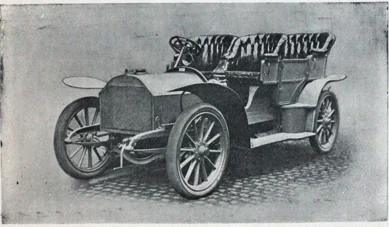
Berliet 40 HP (1904)
Los Deportes of 12 June 1904 reported that a party had been held to welcome a Berliet 40 H.P., and the article described the vehicle as follows:
"...It takes the form of a closed limousine, magnificent in appearance and with all the improvements that the Berliet firm of Lyon has introduced in its 1904 model.
The bodywork, black with gold pinstriping, gives a sober and elegant effect.
The chassis has four different speeds and reverse, with some changes of detail to the control lever, fourth speed being direct drive.
The carburettor is a new model called extra-sensitive, and the air intake is adjusted from the driver's seat. Lubrication is automatic, by a new system.
The bearings are ball bearings and ignition is by Simms-Bosch magneto.
The engine, a new 1904-type model, has four cylinders with mechanically operated valves (soupapes commandées) and develops an effective 45 to 46 horsepower.
The exhaust gases leave through a pipe running to the rear end of the car, so they never bother either the chauffeur or the passengers.
The radiator, of the nid d'abeilles (honeycomb) type, contributes modestly to the elegance of the chassis as a whole.
Four large acetylene lamps cast a brilliant light many metres ahead, the lighting gas being produced in two separate purpose-made generators.
The fuel tank is fitted at the rear of the car, next to the axle of the two rear wheels.
Two brakes on the differential, entirely of metal, are worked by the driver with a single lever and can close in both directions, besides other new brakes, also pneumatic, applied by foot on the wheels, completely silent and protected from the mud and dust of the roads. Further details could be given to vouch for the workmanship of this car, but we omit them for the sake of brevity and because they are mere minutiae..."