
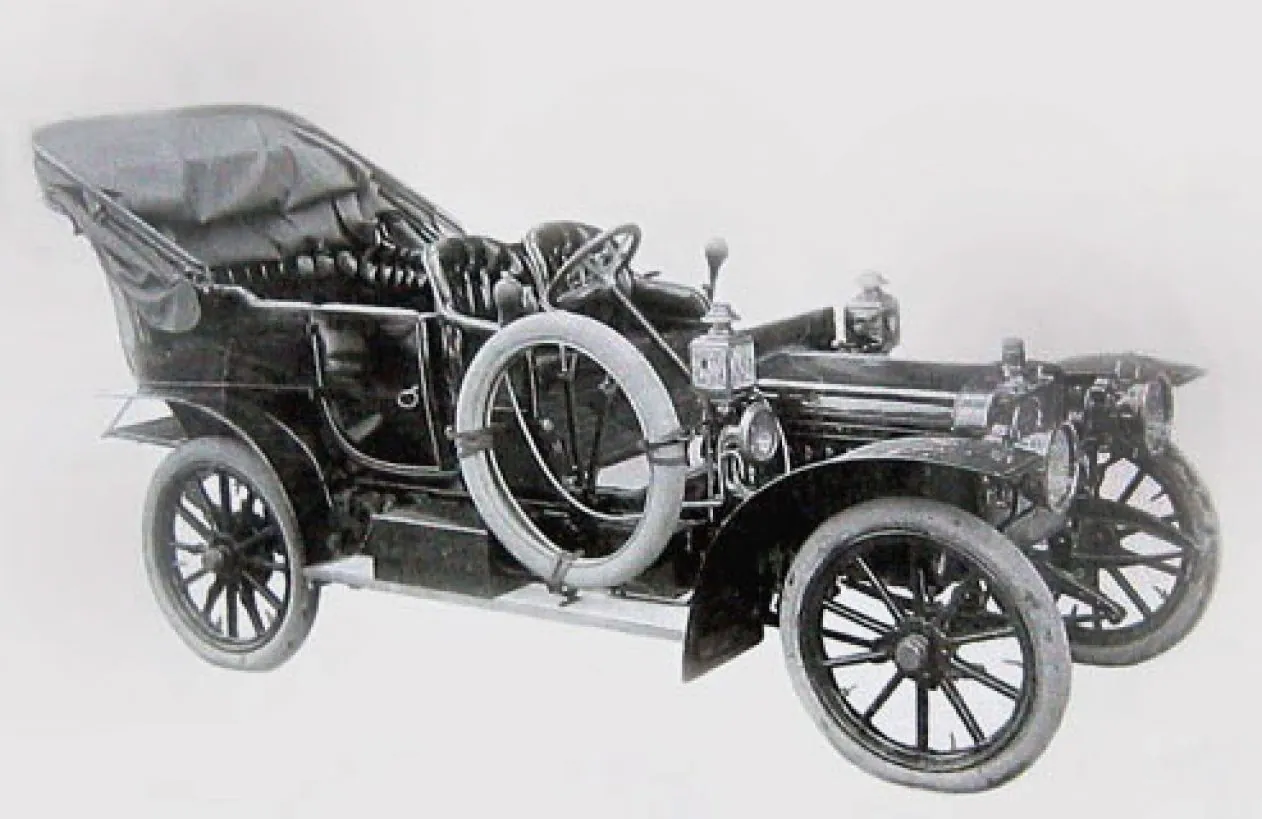
Catalogue · Hispano-Suiza
Hispano-Suiza, Barcelona's car maker (1904–1946), at the Auto Garage Términus

Who founded Hispano-Suiza? Damià Mateu, Francisco Seix and Marc Birkigt (1904)
When the J. Castro company went bankrupt, Francisco Seix Zaya persuaded his friend Damià Mateu i Bisa, a lawyer and businessman in the metalworking sector who was also one of Castro's creditors, to take over the works. Damià Mateu also listened to Birkigt's arguments and became interested in the future of motoring.
As a result of these initial talks, a feasibility study appeared on 1 April 1904 with an exhaustive analysis of why both La Cuadra and Castro had failed in their respective ventures. Essentially, the study concluded that the main problem of the earlier companies had been a lack of sufficient funds to develop prototypes and buy suitable machinery.
And so, on 14 June 1904 a new company was incorporated, "La Hispano-Suiza, Fábrica de Automóviles, S. A.". Damià Mateu was to be chairman, Francisco Seix vice-chairman and Marc Birkigt technical director.
The company's initial capital was 500,000 pesetas, half of it issued in 1904 and the remaining half the following year, making 1,000 shares of 500 pesetas each.
Work at the new company began in J. Castro's own premises in Carrer de Floridablanca. The first task was to finish the last Castro cars still outstanding. Thus, at the end of 1904 two 10 hp Castros were delivered, together with the first two cars put on sale under the Hispano-Suiza name, both of 14 hp. One of these Hispano-Suizas was bought by an Argentinian for 14,000 pesetas of the day.
The Castro 14/16 hp was the basis of the first Hispano-Suiza, a 20 hp, 3,770 cc car that went on sale in the first days of January 1905. This was to be the most successful model of the first series and the one with which the make's racing victories began.
In August 1905 Marc Birkigt travelled to Geneva with the make's sales agent, Ernest Stofler, to close an agreement under which the "Société d'Automobiles à Génève" acquired the rights to build cars under Hispano-Suiza licence.
Thanks to their reliability, quality and elegance, Hispano-Suiza cars were soon regarded as luxury cars and symbols of social prestige. They were also fast enough to earn a place in the early motor races and win many competitions.
As was customary at the time, luxury car manufacturers delivered only the chassis and engine, and it was up to the client to choose a coachbuilder to build the body to his own taste and specifications. This opened the way for Hispano-Suizas to carry bodies designed by the finest coachbuilders in Spain and Europe.
Source: Wikipedia
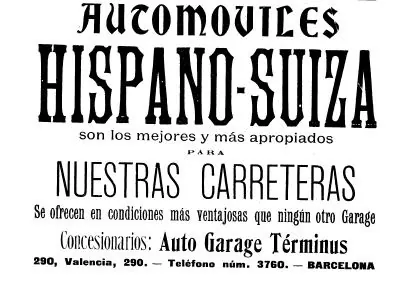
Advertisement published in Los Deportes on 28 January 1905
